
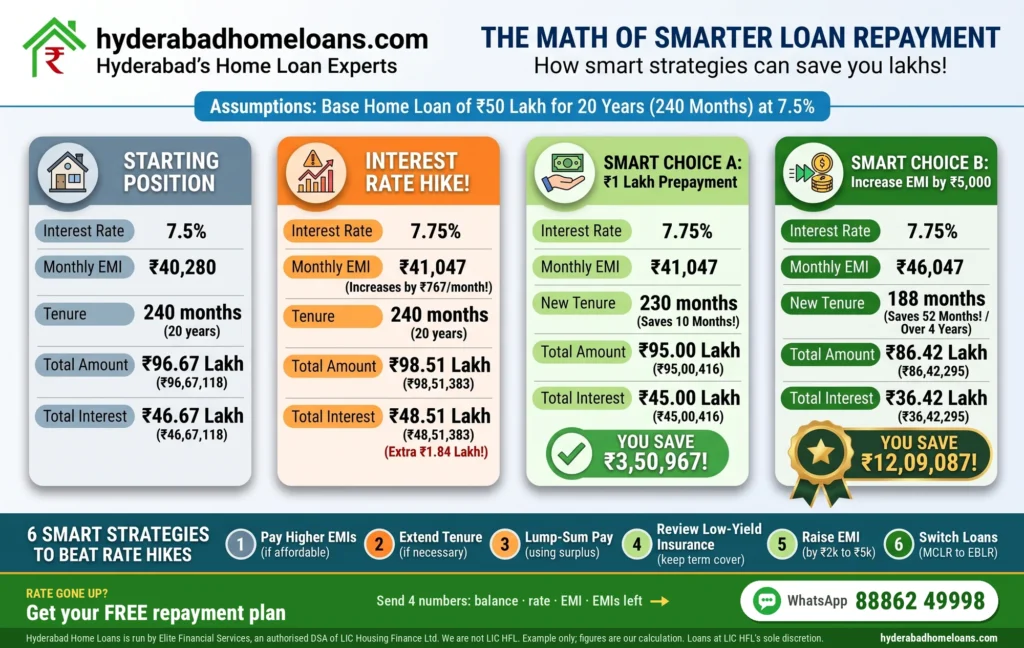
Quick answer: If you can afford it, choose the higher EMI. On a ₹50 lakh, 20-year loan whose rate rises from 7.5% to 7.75%, a higher EMI (+₹767) adds ₹1.84 lakh of interest; keeping the EMI and stretching the tenure adds ₹4.56 lakh. Adding ₹5,000 a month cuts interest by ₹12.09 lakh and 52 EMIs.
By Vijay Arjun V (B.Pharm, PGDM): authorised LIC HFL DSA since 2002 and DME (Direct Marketing Executive) appointed by LIC HFL. RBI and bank rate changes checked on 18 October 2026; LIC HFL rates checked on lichousing.com on 18 October 2026. Every loan figure here is our calculation.
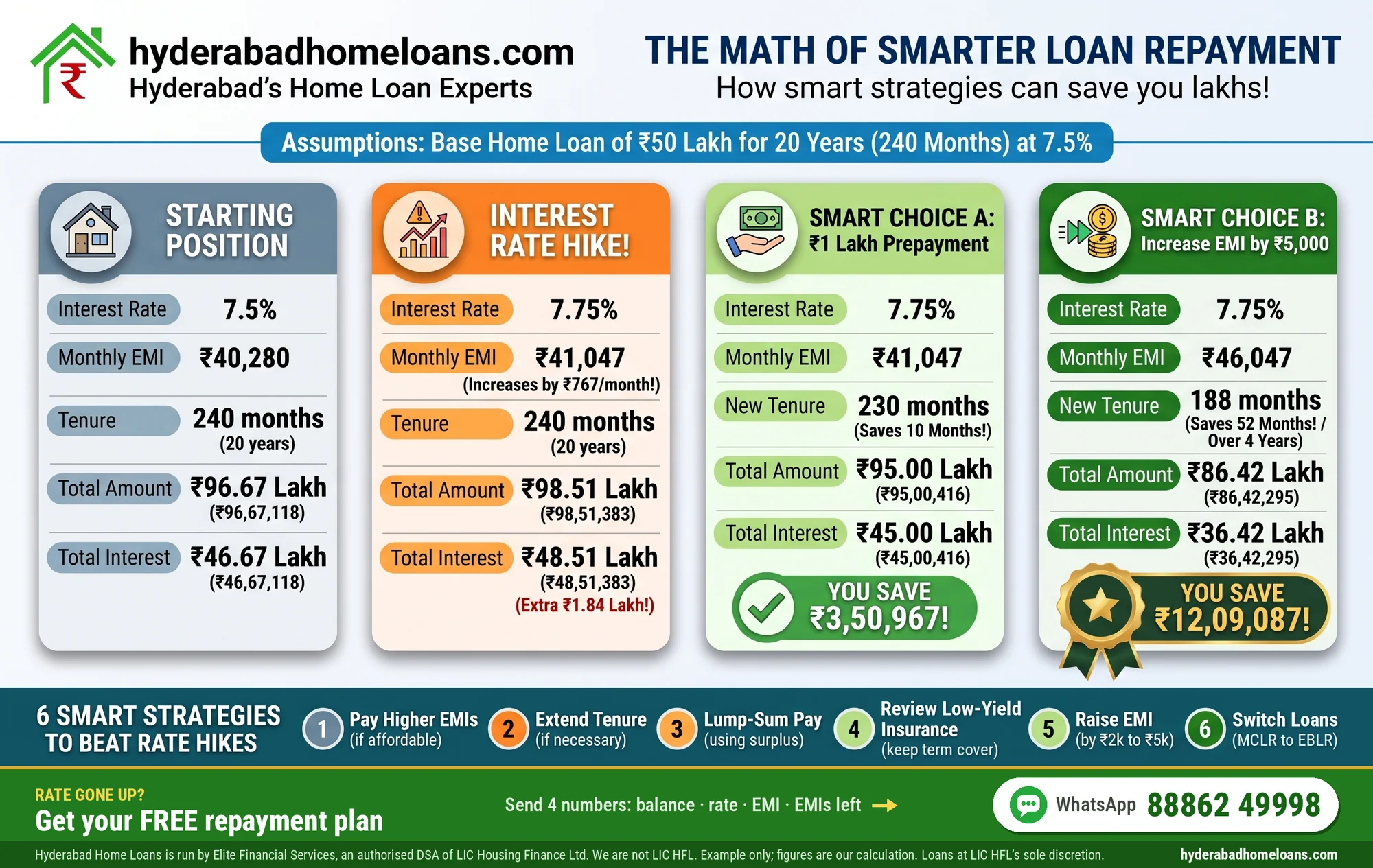
The infographic above is our calculation for a ₹50 lakh, 20-year loan. Open it full size or share it on WhatsApp.
The message that looks harmless
Imagine Ravi and Swathi, a couple in Kukatpally with a ₹50 lakh home loan for 20 years at 7.5%. Their EMI is ₹40,280. (They are an illustration; the numbers are real calculations.)
On 7 October 2026 the RBI raised the repo rate by 0.25% to 5.50%, and banks began raising their repo-linked lending rates the next day. Say their loan resets to 7.75%, and the lender’s message says the EMI stays the same.
It sounds painless. It isn’t. At a higher rate, the same EMI repays less of the loan each month, so the loan runs 252 months instead of 240 and the interest bill rises from ₹46.67 lakh to ₹51.23 lakh. That one quiet change costs them ₹4.56 lakh.
Here is what they could do instead, and what each choice is worth.
Should you increase your EMI or your tenure when rates rise?
Increase the EMI if your budget allows: it costs far less. RBI rules require lenders, including housing finance companies, to let you choose a higher EMI, a longer tenure or a mix when a floating rate resets, and to tell you about any change straight away (RBI circular on reset of floating rates).
| Choice | Rate | EMI | EMIs | Total interest | Extra vs original |
|---|---|---|---|---|---|
| Original loan | 7.50% | ₹40,280 | 240 | ₹46.67 lakh | — |
| Rate rises, EMI unchanged (tenure grows) | 7.75% | ₹40,280 | 252 | ₹51.23 lakh | +₹4.56 lakh |
| Rate rises, EMI raised (tenure unchanged) | 7.75% | ₹41,047 | 240 | ₹48.51 lakh | +₹1.84 lakh |
The higher EMI costs ₹767 a month more and saves ₹2.72 lakh compared with the stretched tenure. The table assumes the new rate applies from the first EMI. On a loan that has already run for a few years, the amounts are smaller, but the higher EMI still costs less.
How much can a prepayment or a higher EMI save?
More than the rate hike costs. Starting from the loan at 7.75% with the EMI raised to ₹41,047:
| Move | EMIs | Total interest | Interest saved | Loan ends |
|---|---|---|---|---|
| No extra payment | 240 | ₹48.51 lakh | — | 20 years |
| ₹1 lakh prepaid once (after the first EMI) | 230 | ₹45.00 lakh | ₹3.51 lakh | 19 years 2 months |
| EMI raised by ₹2,000 | 216 | ₹42.74 lakh | ₹5.78 lakh | 18 years |
| One extra EMI paid each year | 204 | ₹39.97 lakh | ₹8.54 lakh | 17 years |
| EMI raised by ₹5,000 | 188 | ₹36.42 lakh | ₹12.09 lakh | 15 years 8 months |
| ₹1 lakh prepaid every year | 168 | ₹32.27 lakh | ₹16.25 lakh | 14 years |
| EMI raised 5% every year (with pay rises) | 149 | ₹31.70 lakh | ₹16.82 lakh | 12 years 5 months |
Money paid early works hardest: a single ₹1 lakh prepayment saves ₹3.51 lakh of interest. Regular amounts add up to more. ₹5,000 extra each month ends the loan 4 years 4 months early.
Back to our example. Say Ravi and Swathi take the higher EMI at reset, add ₹5,000 a month from Swathi’s pay rise and prepay ₹1 lakh from bonuses each year. Their loan would close in 11 years 11 months instead of 21 years, with ₹24.46 lakh less interest than if they had ignored that message.
6 smart moves to beat a rate hike
- Pay a higher EMI if you can afford it. At reset, it is the cheapest response.
- Extend the tenure only if necessary. Choose it if a higher EMI would strain your budget, and raise the EMI later when you can.
- Prepay lump sums from surplus money. Use bonuses or maturing deposits, but keep an emergency fund of about six months’ expenses, EMIs included. Banks and housing finance companies can’t charge you for prepaying a floating-rate home loan taken in your own name for a non-business purpose (RBI Pre-payment Charges Directions, 2025).
- Review low-yield insurance policies, but keep your term cover. If an insurance-cum-savings plan earns less than your loan costs, ask a licensed adviser whether making it paid-up or surrendering it makes sense. Surrendering in the early years usually returns less than you paid in, and your family still needs life cover while the loan runs.
- Raise your EMI by ₹2,000–5,000. Do it after each pay rise: ask your lender to increase the EMI or make a regular part-prepayment.
- Switch to a lower rate. On an older bank loan linked to MCLR or the base rate, ask your bank about moving to its repo-linked rate (EBLR), usually for a fee. Or transfer the loan to a lender with a lower rate.
Paying 8.5% or more? Check a switch first
If your rate is well above today’s best rates, a lower rate can save more than any single move above. With ₹50 lakh and 20 years to go, moving from 8.5% to 7.5% cuts the EMI by ₹3,112 and the interest by ₹7.47 lakh.
LIC HFL’s published home loan rates hadn’t changed after the RBI hike when we checked on 18 October 2026: from 7.15% for salaried borrowers with a CIBIL score of 825 or more, and 7.30% for self-employed borrowers (lichousing.com). LIC HFL prices floating loans off its own benchmark, so its rates can change too. See the October 2026 rates and what the hike means.
LIC HFL’s Homecoming offer waives the processing fee on balance transfers and top-ups for borrowers with a CIBIL score of 725 or more and an 18-month default-free repayment record (LIC HFL); LIC HFL has communicated that it runs until 31 December 2026. Before you switch, ask your current lender to match the rate, and count every switching cost against the saving: see how much a balance transfer saves and our balance transfer to LIC HFL page.
Get your free repayment plan
Frequently asked questions
Does the repo rate hike raise my home loan EMI automatically?
A repo-linked bank loan changes on the reset date in your loan agreement. Banks including PNB, Indian Bank, Bank of India and Indian Overseas Bank raised these rates from 8 October 2026 (PTI, 7 October 2026). MCLR loans change on their own reset dates. Housing finance companies such as LIC HFL use their own benchmark. Whichever applies, the lender must tell you and let you choose between a higher EMI and a longer tenure.
After a prepayment, should I reduce the EMI or the tenure?
Reduce the tenure if you can manage the EMI: it saves more interest. See the worked examples in home loan prepayment: how much interest you save.
Should I prepay or invest the money?
Prepaying earns you your loan rate without risk. Keep your emergency fund first, then compare the after-tax return you expect from investing. Under the old tax regime, prepaying also lowers the interest you can deduct: see home loan tax benefits for 2026.
Is there a charge for prepaying a home loan?
Not on a floating-rate home loan taken by an individual for a non-business purpose, whether the lender is a bank or a housing finance company. Fixed-rate loans can carry charges; check your sanction letter.
Should I move my bank loan from MCLR to EBLR?
If your MCLR or base-rate loan costs more than the bank’s current repo-linked rate, ask the bank for the new rate and the conversion fee. A repo-linked rate passes on repo changes faster, in both directions. Compare that offer with a balance transfer before you decide.
Sources: RBI Monetary Policy Statement (7 October 2026); RBI, Reset of floating interest rate on EMI-based personal loans (18 August 2023, updated 1 October 2025); RBI Pre-payment Charges on Loans Directions (2 July 2025); PTI report on bank lending rates (7 October 2026); LIC HFL rates and Homecoming terms on lichousing.com, checked 18 October 2026. All loan figures are our calculation.
Hyderabad Home Loans is run by Elite Financial Services, an authorised Direct Selling Agent (DSA) of LIC Housing Finance Ltd. We are not LIC HFL. Loans are sanctioned solely at LIC HFL’s discretion; rates and fees may change.
Related guides
October 24, 2026
Home Loan Eligibility for ₹1.5 Lakh & ₹2 Lakh Salary in Hyderabad: Luxury Flat Budget Guide (2026)
October 24, 2026
How Existing Personal & Car Loans Affect Home Loan Eligibility in Hyderabad (And 5 Ways to Fix It)
October 24, 2026
Self-Employed Home Loan Eligibility in Hyderabad: ITR Calculation, Business Income & Norms (2026)